
Choosing the right word in English can be tricky, especially when two words sound similar but mean different things. Tapping vs taping is one such example. Both describe actions, yet their meanings and applications differ greatly. Using the wrong word can confuse readers or make writing seem careless.
Understanding the distinction between tapping and taping is essential for clear communication. In this article, we will explore the definitions, usage, common mistakes, context, and examples to help you confidently choose the right word every time.
Read this: IWK Meaning in Text: What It Stands For and How to Use It Online Update 2026
Define Tapping
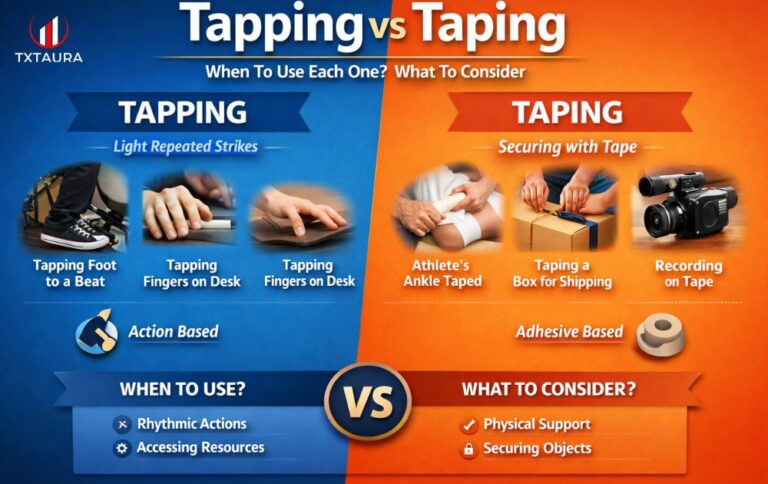
Tapping refers to lightly striking something, often repeatedly. It appears in music, martial arts, therapy, and everyday actions. In music, tapping can mean creating rhythms on a guitar fretboard or tapping a foot to keep time.
Martial arts use tapping as a signal of submission or acknowledgment. In therapy, tapping is part of the Emotional Freedom Technique (EFT), where specific points on the body are tapped to reduce stress, anxiety, or emotional tension. Tapping can also describe abstract actions, like accessing resources or ideas.
Define Taping
Taping involves applying adhesive tape to secure, stabilize, or support an object or body part. It is widely used in sports medicine, physical therapy, and everyday tasks like shipping or crafts. Types of tape include kinesiology tape, which stretches to mimic skin movement, athletic tape for compression and support, and rigid tape for immobilization.
Taping also applies to recording, such as capturing audio or video on tape. This action is about binding, holding, or protecting, rather than striking, which distinguishes it from tapping.
How To Properly Use The Words In A Sentence
Using tapping and taping correctly requires attention to context and action. Though they may sound alike, their applications are very different.
How To Use “Tapping” In A Sentence
“Tapping” describes lightly hitting or accessing something. Examples include:
- She was tapping her pencil on the desk while thinking.
- He tapped the machine to get it working again.
- The company is tapping into new resources for growth.
Notice how tapping can describe both physical movement and abstract action, like utilizing a source.
How To Use “Taping” In A Sentence
“Taping” refers to applying tape or recording. Examples include:
- She was taping the box for shipping.
- He taped the poster to the wall carefully.
- The band was taping their performance for a later release.
This word is specific to securing or recording, which differentiates it clearly from tapping.
More Examples Of Tapping & Taping Used In Sentences
Seeing practical examples helps solidify the differences.
Examples Of Using “Tapping” In A Sentence
- The therapist was tapping on the patient’s back to release tension.
- The musician tapped his fingers on the guitar to maintain rhythm.
- The athlete was tapping his feet on the starting line.
- She tapped her phone screen to scroll through messages.
- The carpenter tapped nails gently into the wood.
Examples Of Using “Taping” In A Sentence
- The doctor taped the patient’s arm to stabilize it.
- The painter taped wall edges to prevent paint spills.
- The athlete taped his ankle before the game.
- The carpenter taped the wood edges to avoid splinters.
- The actor taped his lines on a sheet for rehearsal.
Common Mistakes To Avoid
Many people misuse tapping and taping, assuming they are interchangeable. Understanding common pitfalls ensures clarity.
Using Tapping And Taping Interchangeably
One frequent mistake is treating both actions as the same. Tapping involves fingertip strikes or rhythmic motion, whereas taping requires adhesive tape for support. Misuse can confuse instructions or mislead readers.
Assuming Tapping And Taping Have The Same Benefits
Tapping, especially EFT, reduces stress and emotional tension. Taping provides physical support, stabilizes joints, and prevents injuries. Assuming they deliver identical benefits ignores their unique purposes.
Not Using Tapping And Taping Properly
Incorrect technique lessens effectiveness. Tapping requires targeting specific points and rhythm, while taping demands correct placement and tension. Ignoring proper methods reduces results.
Tips To Avoid Common Mistakes
Learn the correct terminology and consistently apply it. Recognize the differences between tapping and taping. Follow proper techniques, and seek professional guidance if unsure. Proper usage enhances communication and safety.
Context Matters
Context determines whether tapping or taping is appropriate. Consider the material, environment, and intended action before choosing between the two.
Examples Of Different Contexts
Industrial Applications
In industries, tapping is often preferred for strong, secure connections in metal or vibrating environments. It ensures reliability where tape might fail.
Medical Applications
Taping is crucial in medical settings. It prevents skin damage, provides joint support, and allows flexibility during movement. Taping ensures safety in physical therapy and sports.
Electrical Applications
Taping insulates wires and prevents short circuits. Tapping might secure components temporarily or mechanically in assembly. Combining both can achieve optimal results in electrical projects.
DIY Projects
Taping helps hold materials temporarily or permanently, especially soft surfaces. Tapping may be used for assembly requiring repeated light strikes without adhesives. Choosing correctly improves project outcomes.
Exceptions To The Rules
Certain scenarios require deviation from standard rules for tapping and taping.
Medical Conditions
Hypermobility syndrome may need taping to stabilize joints. Plantar fasciitis sufferers might use tapping to relieve foot pain. Adaptations ensure proper support or relief.
Athletic Performance
Swimmers may tape to reduce drag, while runners may tap strategically to enhance gait or rhythm. Performance goals influence technique choice.
Personal Preferences
Some individuals prefer tapping acupressure points for stress, while others select decorative tapes for aesthetics. Personal needs can guide application safely.
Practice Exercises
Practice ensures mastery of usage.
Exercise 1: Fill In The Blank
- She was __________ her foot to the music.
- The athlete was __________ his ankle before the game.
- I am __________ this lecture to review later.
- The plumber was __________ the leaky pipe.
Answer: tapping, taping, taping, taping
Exercise 2: Multiple Choice
- He was _________ his fingers on the table. a) tapping b) taping
- The doctor was _________ the patient’s knee. a) tapping b) taping
- She was _________ the gift wrap to the present. a) tapping b) taping
Answer: tapping, tapping, taping
Conclusion
Understanding the distinction between tapping and taping improves clarity and communication. Tapping involves striking lightly, while taping involves securing with tape. Correct use ensures precision in writing and practical applications. Misusing these words can cause confusion, reduce credibility, or create mistakes in professional and everyday contexts. Practice, context awareness, and proper technique make all the difference in mastering these actions. Always consider the situation, audience, and purpose to choose accurately between tapping and taping. Continuous learning strengthens language skills and practical knowledge alike.
Key Takeaways From The Article:
Tapping and taping have distinct definitions, uses, and benefits. Tapping involves light striking, while taping secures or supports. Correct usage prevents confusion. Context determines the right choice. Practice and guidance enhance mastery.
What is the difference between tapping and taping?
Tapping involves striking lightly, often rhythmically. Taping involves applying adhesive tape for support, recording, or securing objects.
Can tapping be used for stress relief?
Yes, tapping in Emotional Freedom Technique (EFT) reduces anxiety, stress, and emotional tension by targeting specific points on the body.
Is taping only for athletes or medical use?
No, taping applies in DIY projects, shipping, crafts, and electrical work, as well as in sports medicine and therapy.
Can tapping and taping be used together?
Sometimes both techniques are combined, depending on context, such as in industrial assembly or sports training for enhanced performance or stability.
What are common mistakes with tapping and taping?
Common errors include using them interchangeably, assuming same benefits, and not following proper technique, which can cause confusion or ineffective results.

