
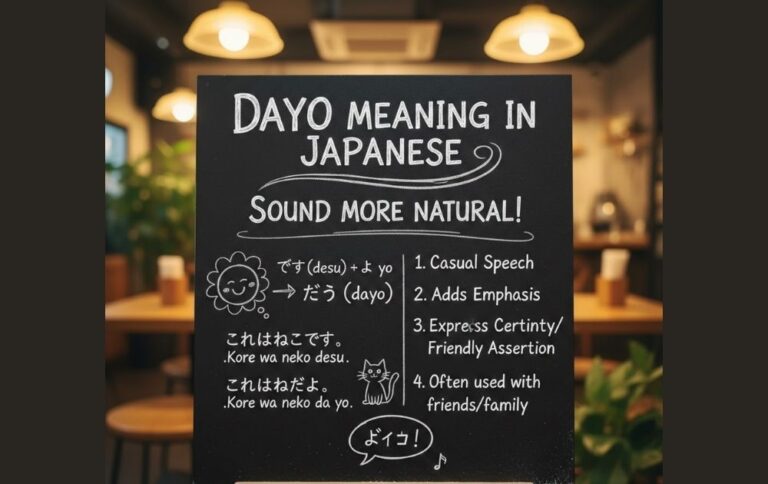
In Japanese, dayo (だよ) is a casual sentence-ending particle used to add emphasis, certainty, or a friendly “you know?” tone. It’s similar to saying “It is!” or “I’m telling you” in English and is typically reserved for conversations with close friends and family.
As the informal counterpart to the polite desu (です), dayo should be avoided in formal situations or when speaking to strangers or superiors, where it can come across as overly assertive or slightly know-it-all in tone.
What Does Dayo Mean in Japanese?
So, what does dayo mean in Japanese? Simply put, it’s a casual way to say “it is” while adding a little punch to your sentence. You’ll hear it all the time in relaxed chats, especially among friends or in anime. Basically, it takes the plain “da” (meaning “is”) and tacks on the particle “yo,” which acts like a nudge to share or emphasize information. This small word is a big key to sounding natural and friendly instead of stiff and textbook-perfect.
Now, let’s break down how it works for clarity:
- DA (だ): This is the casual version of the polite “desu” (です). It simply means “is,” “am,” or “are.”
- YO (よ): This is an emphasis particle. Think of it as saying “you know?”, “I’m telling you,” or “listen!” It shows you’re giving info or correcting someone gently.
Therefore, when you combine them, dayo transforms a plain statement into a confident, conversational one. For example, “Sore wa hon da” (“That is a book”) becomes “Sore wa hon dayo” (“That’s a book, you know?”). Just remember to use it only in informal situations, as it can sound too blunt or even rude with strangers or superiors. Mastering this tiny word will make your Japanese flow much more naturally.
The Difference Between Dayo and Desu
Understanding the difference between です (desu) and だよ (dayo) is important for navigating Japanese social etiquette and achieving natural conversation. The core distinction lies in formality levels and emotional tone.
です (Desu) is the foundation of polite Japanese. It acts as the standard copula (linking verb meaning “is/am/are”) in formal speech. You use it to show respect, creating social distance with strangers, superiors, or in business settings. For example, stating “これは本です” (Kore wa hon desu – “This is a book”) is grammatically correct and universally safe but can sound unnecessarily stiff among friends.
In contrast, だよ (Dayo) is a pillar of casual Japanese and friendly conversation. It combines two key sentence-ending particles:
- だ (Da): The informal copula, directly replacing desu.
- よ (Yo): An emphasis particle that adds nuance, like saying “I’m telling you!” or “you know?”.
This combination creates an assertive tone used for sharing information, gentle correction, or making declarations with people you’re close to. Saying “これは本だよ” (Kore wa hon dayo) means “This is a book, you know?” and sounds friendly and natural in informal dialogue.
| Desu (です) | Dayo (だよ) |
| Formal/polite | Casual/friendly |
| Used in business, with strangers | Used with friends, family |
| Sounds stiff in casual settings | Sounds natural in daily conversation |
| “Kore wa hon desu” (This is a book) | “Kore wa hon dayo” (This is a book!) |
Therefore, the key is context. Using dayo in formal situations is a serious faux pas and can seem rude, while overusing desu with friends might make you sound like a “textbook gaijin.” Mastering this switch is essential for authentic communication and is a clear sign of advancing beyond basic Japanese grammar into more natural speech patterns.
Common Usage Patterns for Dayo
The phrase だよ (dayo) is versatile in casual Japanese conversation. Its core function is to add assertion or shared emphasis, but its nuance shifts beautifully with context. Here are its primary usage patterns.
1. Making Assertions or Declarations
This is the most fundamental use. Here, dayo adds confidence and certainty to a statement, similar to saying “I’m telling you” or “for sure.”
- Example: 明日は雨だよ。(Ashita wa ame dayo.)
- Meaning: “It’s going to rain tomorrow (I’m sure of it).”
2. Providing New Information
Dayo often acts as a soft spotlight, gently pointing out something you believe the listener doesn’t know. It carries a nuance of “just so you know” or “here’s something for you.”
- Example: この店のラーメン、おいしいだよ。(Kono mise no rāmen, oishii dayo.)
- Meaning: “The ramen at this shop is delicious (in case you were wondering).”
3. Offering Gentle Correction or a Reminder
When someone is mistaken or has forgotten, dayo is used to correct them in a friendly, non-confrontational way. It softens the correction, implying “actually, it’s like this.”
- Example: 違うよ、映画は7時からだよ。(Chigau yo, eiga wa shichi-ji kara dayo.)
- Meaning: “No, the movie starts at 7 (just to remind you).”
4. Sharing Thoughts or Feelings (with “I think/feel”)
When expressing an opinion or feeling using a phrase like “I think that…” (~と思う), adding dayo makes the sharing sound more engaged and direct.
- Example: 君ならできると思うよ。(Kimi nara dekiru to omou yo.)
- Meaning: “I think you can do it (I really believe so).”
The intonation when speaking is vital. A flat tone can sound blunt or annoyed, while a lighter, conversational tone conveys the intended friendly emphasis. Mastering these patterns is a major step toward natural dialogue and moving beyond textbook Japanese.
Dayo vs. Deshou: Understanding the Distinction
A key step in moving from textbook Japanese to natural conversation is mastering particles that shape meaning. The difference between だよ (dayo) and でしょう (deshou) is a classic example, centered on certainty versus speculation.
だよ (Dayo): The Particle of Assertion
Asserts a fact or statement with confidence and shared emphasis. It’s used for what you know or strongly believe.
Nuance: “It is,” “I’m telling you,” “you know?”
Context: Predominantly casual speech.
Example (Asserting a Known Fact):
Japanese: この答えは正しいだよ。
Romaji: Kono kotae wa tadashii dayo.
English: “This answer is correct (I’m telling you).”
でしょう (Deshou): The Particle of Speculation & Confirmation
Core Function: Expresses probability, makes predictions, or seeks agreement. It’s used for what you think, infer, or want to confirm.
Nuance: “Probably,” “I suppose,” “right?”
Context: Used in both polite and casual registers.
Primary Uses:
Seeking Confirmation (Rising Intonation):
Japanese: 明日、会議があるでしょう?
Romaji: Ashita, kaigi ga aru deshou?
English: “There’s a meeting tomorrow, right?”
Making Predictions (Flat Intonation):
Japanese: 彼はすぐに到着するでしょう。
Romaji: Kare wa sugu ni tōchaku suru deshou.
English: “He will probably arrive soon.”
The Crucial Contrast
The choice hinges on your level of certainty:
Use だよ to declare information (“It’s expensive!”).
Use でしょう to guess (“It’s probably expensive”) or check (“It’s expensive, right?”).
Mixing them up is a common learner mistake. Saying “彼は医者だよ?” with questioning intent sounds unnatural, while using “でしょう” to state a clear fact can make you sound oddly hesitant.
Gender Differences in Using Dayo
Traditionally, the use of だよ (dayo) in Japanese carried noticeable gendered speech patterns, which can still be observed in media and some social contexts today.
Male Speech: Men have commonly used だよ as a straightforward, assertive way to emphasize a point in casual conversation. It sounds direct and confident.
Example: それは面白いだよ。 (That’s interesting, I tell you.)
Female Speech: Women traditionally softened their expression by:
- Using だわ (dawa) for a gentle, classic feminine tone.
- Using よ (yo) alone (without だ) for a lighter emphasis.
- Using のよ (noyo) to blend explanation with soft assertion.
Example: それ、美味しいわよ。 (That’s delicious, you know.)
How to Sound Natural with Dayo
Using だよ (dayo) naturally isn’t just about knowing its meaning, it’s about mastering context, tone, and rhythm in everyday Japanese. Here’s how to move from correct to natural.
🎧 Listen Actively to Real Speech
Immerse yourself in casual spoken Japanese—watch slice-of-life anime, YouTube vlogs, or dramas where friends talk naturally. Pay attention to:
- When and why speakers use だよ.
- The intonation, is it light, excited, or gently corrective?
- What comes right before it, a noun, adjective, or verb?
🗣️ Practice with Feeling, Not Just Words
Don’t just memorize sentences—imitate the emotion.
- If someone says, “それ、美味しいだよ!” with a smile, repeat it with the same friendly emphasis.
- Try saying it flat—then with feeling. Notice how the feeling changes the meaning.
🔁 Start Small in Safe Settings
Begin using だよ in low-pressure situations:
- In language exchange chats.
- When answering a friend’s question casually.
- When confirming or reminding in a friendly tone.
A good starter pattern:
[Fact] + だよ。
Example:
“テストは明日だよ。” (The test is tomorrow, just so you know.)
Avoid These Common Pitfalls
- Don’t overuse it—not every sentence needs だよ.
- Never use it in formal settings—it can sound rude or too familiar.
- Match your intonation to your intent—a flat tone can sound annoyed or cold.
- Don’t use it with questions—だよ is for statements, not questions.
🔄 Blend It with Related Expressions
Once comfortable with だよ, mix in similar casual particles to sound even more fluid:
- …んだよ – for giving explanations or reasons.
- …よね – when seeking agreement.
- …じゃん – very casual, like “isn’t it?” (common among young people).
Common Mistakes When Using Dayo
- Using it in formal situations – Never use dayo with your boss, teacher, or strangers. It’s only for friends, family, and casual settings.
- Overusing it in every sentence – It sounds unnatural. Use it only when you really want to add emphasis or share information.
- Using flat intonation – Dayo isn’t monotone. It needs a slightly raised or expressive tone to sound friendly and not blunt or annoyed.
- Adding it to questions – Dayo is for statements, not questions. Use it to tell, not to ask.
- Mixing up dayo and deshou – Dayo is for what you know (“He is coming”). Deshou is for what you think (“He will probably come”) or when you want to check (“He is coming, right?”).
In short: use it casually, sparingly, expressively, for statements only, and only when you’re sure.
Beyond Dayo: Related Casual Japanese Expressions
Once you’re comfortable with だよ (dayo), you can make your Japanese sound even more natural by using related casual particles and sentence endings. Here are a few common ones:
んだ / んです (nda / ndesu)
Used to give an explanation, reason, or background.
Example:
忙しいんだ。 (Isoishii nda.)
“The thing is, I’m busy.”
よね (yone)
Used when you’re pretty sure the listener agrees or knows what you’re talking about. It means “right?” or “isn’t it?”.
Example:
今日は暑いよね。 (Kyō wa atsui yone.)
“It’s hot today, isn’t it?”
じゃん (jan)
Very casual “isn’t it?” / “see?” Used especially among young people.
Example:
それ、かっこいいじゃん! (Sore, kakkoii jan!)
“That looks cool, doesn’t it?”
の (no)
Adds a soft, explanatory tone. Common in feminine speech, but used by everyone casually.
Example:
もう行くの。 (Mō iku no.)
“I’m going now, okay?”
わ (wa)
Adds a mild, slightly feminine emphasis. Can also sound old-fashioned or regional depending on context.
Example:
すごいわ! (Sugoi wa!)
“Wow, that’s amazing!”
っけ (kke)
Used when you’re trying to recall something. Like “…was it?”
Example:
彼の名前、何だっけ? (Kare no namae, nan da kke?)
“What was his name again?”
Practical Examples of Dayo in Action
Here’s how だよ (dayo) can be used in real-life situations, showing its natural flow and emotional tone in casual Japanese conversation.
Situation 1 – Sharing news with excitement
You just got a new job and want to tell your friend.
Japanese: 新しい仕事、決まったんだよ!
Romaji: Atarashii shigoto, kimatta n dayo!
English: “I got the new job — can you believe it?”
Here, んだよ adds an explanatory, excited emphasis.
Situation 2 – Correcting someone gently
Your friend thinks the meeting is at 2 PM, but it’s actually at 3.
Japanese: ううん、3時からだよ。
Romaji: Ūn, san-ji kara dayo.
English: “No, it starts at 3, just so you know.”
Used here for friendly correction without sounding harsh.
Situation 3 – Reminding someone of a plan
Your sister forgot you were meeting for lunch today.
Japanese: 今日、ランチの約束あっただよ!
Romaji: Kyō, ranchi no yakusoku atta dayo!
English: “We had lunch plans today, remember?”
Adds a nudge-like, reminder tone.
Situation 4 – Expressing your opinion assertively
Recommending your favorite restaurant to a friend.
Japanese: あの店のパスタ、絶対美味しいだよ。
Romaji: Ano mise no pasuta, zettai oishii dayo.
English: “That place’s pasta is seriously delicious, trust me.”
Shows confidence and personal recommendation.
Situation 5 – Responding to worry with reassurance
A friend is nervous about a test.
Japanese: 大丈夫、君ならできるだよ。
Romaji: Daijōbu, kimi nara dekiru dayo.
English: “It’s okay, you can do this — I believe in you.”
Adds a supportive, encouraging tone.
Integrating Dayo Into Your Japanese Learning Journey
To truly master だよ (dayo) and other essential Japanese expressions, try weaving these simple, effective methods into your routine.
1. Learn from real-life context
Move beyond textbooks and dive into resources that show how Japanese is spoken in everyday life, like TV shows, YouTube vlogs, or podcasts where people chat casually.
2. Practice with real people
Find a language exchange partner or tutor who can give you friendly, instant feedback on when and how to use dayよ naturally.
3. Listen actively to casual speech
When watching anime or dramas, don’t just follow the story, pay special attention to how friends and family talk to each other. Notice the tone, timing, and emotion behind phrases like dayo.
4. Hear your own voice
Record yourself speaking and listen back. It’s one of the fastest ways to improve your intonation and make sure you sound friendly, not flat or robotic.
These steps aren’t just about memorizing, they’re about feeling the language. With time, phrases like dayo will start to come out naturally, without overthinking.
FAQ About Dayo Meaning in Japanese
1. What is the exact meaning of “dayo” in Japanese?
Dayo (だよ) is a casual sentence-ending expression that means “it is” or “that’s how it is,” but with added emphasis, similar to saying “I’m telling you!” or “you know?” in English. It combines the casual form of “is” (だ) with an emphasis particle (よ) to sound friendly and assertive in everyday conversation.
2. Can I use “dayo” with my Japanese teacher or boss?
No. Dayo is strictly for casual, informal situations, like with friends, family, or people you’re very close to. Using it with teachers, bosses, or strangers can sound rude or overly familiar. In formal settings, always use the polite です (desu) instead.
3. How is “dayo” different from “desu”?
です (desu) is polite and formal, used in respectful or distant relationships. だよ (dayo) is casual, direct, and adds emotional emphasis. Think of desu as the neutral “it is,” and dayo as “it is, I’m telling you!” Using desu with friends can sound stiff; using dayo in formal situations is inappropriate.
4. Do both men and women use “dayo” equally?
Traditionally, dayo was more common in male speech, while women often used softer endings like だわ (dawa) or just よ (yo) alone. However, in modern Japanese, many women use dayo casually among friends. Today, it’s more about personal style than strict gender rules.
5. How can I practice using “dayo” correctly?
- Listen actively to casual Japanese media (anime, dramas, vlogs) and notice when dayo is used.
- Practice with language partners who can give you natural feedback.
- Start small, use it in simple statements with friends or in language exchanges.
- Record yourself to check if your intonation sounds friendly and natural, not flat or forced.

