
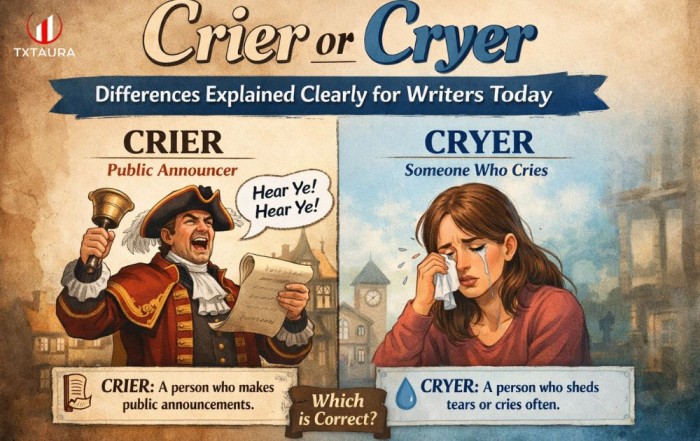
If you’ve ever paused while writing and wondered about crier or cryer, you’re not alone. The spellings look similar. The pronunciation sounds almost the same. Yet the meanings are very different.
I used to think both words meant the same thing. However, once I explored the grammar, history, and usage rules, the distinction became clear. Choosing the correct word improves clarity, strengthens writing, and prevents embarrassing grammar mistakes. Let’s break it down properly so you never confuse cryer vs crier again.
Read This: What Does WYLL Mean in Text? Real Meaning Explained
Define Cryer
The word “cryer” refers to a person who cries or sheds tears. It describes someone emotional or easily moved. For example, you might say, “She’s a cryer during sad movies.”
Although the word appears logical, modern dictionaries rarely recognize it as standard English. Many grammar experts consider it a nonstandard or incorrect spelling. In most formal writing, “cryer” is avoided.
Historically, people sometimes used “cryer” as a spelling variation. Language evolves over time, so spelling inconsistencies were common centuries ago. Still, in modern English usage, the word is generally not accepted.
When writers ask about crier or cryer, they often discover that “cryer” is considered incorrect in formal grammar.
Define Crier
The word “crier” has a completely different meaning. A crier is someone who announces information publicly. The classic example is a town crier.
In medieval times, a town crier walked through the streets ringing a bell and shouting important news. Since newspapers did not exist, this person played a crucial communication role.
A crier can also appear in legal settings. In a courtroom, a court crier announces the judge’s entrance. The word may also describe someone who loudly calls out information in public.
Unlike “cryer,” the word “crier” is fully recognized in English dictionaries. Therefore, when deciding between crier or cryer, “crier” is usually the correct choice.
How To Properly Use The Words In A Sentence
Understanding definitions helps, but practical sentence use matters more. Context determines which word works.
If you describe emotional behavior, you may think of “cryer.” Yet remember that it’s not considered standard English. Instead, most writers simply say “someone who cries easily.”
If you refer to a public announcer, then “crier” is correct. Precision keeps your writing clear and professional.
How To Use “Cryer” In A Sentence
Although “cryer” appears in casual speech, it rarely belongs in formal writing. You might see sentences like:
- She is a cryer during emotional scenes.
- He was always a cryer as a child.
- The baby turned into a constant cryer at night.
These examples show emotional crying. Still, professional writing usually avoids this spelling.
When people search crier or cryer online, they often realize that “cryer” should be replaced with a clearer phrase like “frequent crier” or “someone who cries often.”
How To Use “Crier” In A Sentence
Now let’s use the correct term.
- The town crier announced the king’s decree.
- The court crier called the room to order.
- The auction crier shouted bids to the crowd.
Each sentence shows someone publicly proclaiming information. That’s the key difference.
Writers often compare cryer vs crier and discover that “crier” relates to announcements, not emotional tears.
More Examples Of Cryer & Crier Used In Sentences
Seeing side-by-side examples removes confusion. Below, you’ll notice the contrast clearly.
Examples Of Using “Cryer” In A Sentence:
- She was known as the office cryer during stressful meetings.
- He became a cryer whenever arguments escalated.
- The child was a constant cryer during bedtime.
- Everyone teased him for being a cryer in sad films.
- She admitted she’s always been a cryer at weddings.
These examples focus on emotional reactions. However, remember that formal grammar discourages this spelling.
Examples Of Using “Crier” In A Sentence:
- The town crier rang his bell before speaking.
- A court crier announced the judge’s arrival.
- The auction crier energized the crowd with rapid calls.
- That crier delivered urgent wartime news.
- The festival crier invited everyone to gather in the square.
Notice how every example involves public communication.
When evaluating crier or cryer, always ask: Is this about tears or announcements?
Common Mistakes To Avoid
Many writers misuse these words. Let’s fix that.
Using “Cryer” Instead Of “Crier”
This mistake happens frequently. People assume “cryer” is simply an alternative spelling. It is not.
English dictionaries recognize “crier.” Therefore, replace “cryer” with “crier” whenever you mean a public announcer.
Using “Crier” To Mean “Crybaby”
Another common confusion occurs here. A “crybaby” describes someone who cries excessively in a childish way.
A “crier,” however, does not automatically mean crybaby. It primarily refers to someone who calls out announcements. Context changes meaning, so avoid careless substitution.
Using “Cryer” To Mean “Announcer”
This is incorrect. If someone makes public announcements, the correct term is “crier.”
Many learners search crier or cryer and mistakenly assume both spellings work for announcers. Only “crier” fits that meaning.
Tips To Avoid These Mistakes
- First, remember that “cryer” is not standard English.
- Second, associate “crier” with bells, streets, and announcements.
- Third, check dictionaries when unsure.
- Finally, proofread carefully before publishing.
- Small grammar corrections strengthen credibility.
Context Matters
Word choice always depends on context. Meaning shifts depending on situation, history, and tone.
When deciding between crier or cryer, examine the setting carefully. Is it emotional? Is it historical? Is it legal?
Correct interpretation prevents confusion.
Different Contexts
In medieval towns, a crier delivered official messages. Cryer would be wrong here.
In emotional descriptions, people informally use cryer. However, formal writing prefers alternative phrasing.
In courtrooms, a crier announces proceedings. Again, “cryer” does not belong in legal terminology.
Context guides accuracy.
Exceptions To The Rules
Language isn’t always rigid. A few exceptions exist.
1. Historical Usage
Older texts sometimes used “cryer” as a spelling variant. Spelling standards were inconsistent centuries ago. Still, modern grammar favors “crier.”
2. Regional Differences
British and American English mostly prefer “crier.” Rare informal American usage may show “cryer,” but it remains nonstandard.
3. Creative Writing
Writers sometimes intentionally use “cryer” to reflect dialect, personality, or character background. Creative freedom allows flexibility.
4. Brand Names
Some businesses choose unique spellings for branding. If a company spells its name “Cryer,” you must respect that official spelling.
Practice Exercises
Let’s test your understanding.
Exercise 1: Fill In The Blank
The town ______ announced the festival.
She became a frequent ______ during sad movies.
The court ______ called the session to order.
The baby was a constant ______ at night.
The auction ______ shouted rapidly.
Answers: crier, cryer (informal), crier, cryer (informal), crier.
Exercise 2: Multiple Choice
The ______ rang a bell in the street.
a) cryer
b) crier
She’s always been a ______ at weddings.
a) cryer
b) crier
Answers: b) crier, a) cryer (informal use).
Conclusion
Understanding the difference between cryer and crier improves your writing instantly. While “cryer” describes someone who sheds tears, it is not considered standard English in formal contexts. On the other hand, “crier” correctly refers to a person who publicly announces news or proclamations. Context plays a crucial role in choosing the right word. Therefore, always evaluate meaning before writing. When in doubt, choose “crier” for announcements and avoid “cryer” in professional communication. Mastering small grammar distinctions like this strengthens clarity, boosts credibility, and ensures your message remains accurate and polished.
FAQs
What is the main difference between crier or cryer?
Crier refers to someone making public announcements, while cryer informally describes someone who cries. However, cryer is not standard English in formal writing.
Is cryer a real English word?
Cryer appears in informal use but is not widely recognized in modern dictionaries. Most grammar guides recommend avoiding it in professional writing.
When should I use the word crier?
Use crier when referring to a public announcer, such as a town crier, court crier, or auction crier in formal contexts.
Can crier mean someone who cries?
Technically yes, but that meaning is rare today. Modern usage connects crier primarily with public announcements rather than emotional crying.
Why do people confuse crier or cryer?
Both words sound identical and share similar spelling. Because of this similarity, writers often assume they are interchangeable, which causes confusion.

